

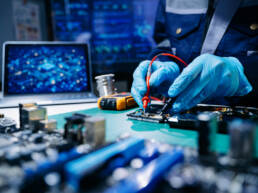
Failure Analysis Expert Witness
When equipment breaks down or a system fails, the difference between a defect, misuse, and ordinary wear often decides who’s liable. I investigate electrical and electronic components, devices, and systems to determine why they failed, using engineering analysis rather than assumption, and I document the reasoning so it holds up when it’s challenged.
I’m a licensed Professional Engineer and Board Certified Diplomate Forensic Engineer with over 30 years of experience, and a Six Sigma Master Black Belt in the quality sciences. That combination matters specifically in failure analysis, because determining root cause often means separating a genuine pattern from ordinary variability in how a product performs in the field.
What I Investigate
Consumer and Commercial Electronics Failures
Including equipment that malfunctioned or exposed someone to a hazard, such as audio and consumer electronics equipment that exposed users to hazardous sound levels well beyond a safe operating range.
Medical Device and Hospital Equipment Malfunctions
Including electrical, electronic, wireless, and networked medical devices. These include nurse call systems, bed alarm systems, medical-alert devices, and various other engineered electronic, wireless, or networked medical devices and systems.
Component-Level Failures
Tracing a breakdown back to a specific defect, design flaw, or misuse, which requires physically examining the failed component alongside its design specifications and usage history.
Product Liability Matters
Electrical or electronic components that failed in the field, where the central legal question is whether the failure stemmed from a defect present at the time of sale or from conditions that arose afterward.
Why Statistical Rigor Matters Here
Most published scientific research can’t be reproduced, a finding the National Academy of Scholars documented in 2018. The same risk applies to analysis conducted without a defensible method. An analysis that identifies a “pattern” of failures without validating that the pattern is statistically real, rather than coincidental, doesn’t hold up well once it’s challenged. Claims of “statistical significance” aren’t always valid. I bring quality science and applied research methods and expertise to your case so you can have the best understanding of the nature of the evidence. I document that methodology clearly so it survives cross-examination.
Discuss Your Case
Fifteen minutes covers the engineering question, any conflicts, and whether my background fits. No charge, no obligation.
My Process
- Initial call. You describe the failure and the questions the case raises, and I tell you directly whether it’s a fit for my background.
- Evidence and documentation review. Once retained, I review the failed component or system, design specifications, maintenance records, and usage history.
- Physical inspection or testing. Many failure cases require hands-on examination of the failed component itself, not just a paper review.
- Statistical validation, where relevant. If the case involves a claimed pattern of failures, I validate whether that pattern is statistically meaningful.
- Report and testimony. A documented opinion on root cause, and testimony where the case requires it.
Why Attorneys Choose Me for Failure Analysis
- Over 30 years of experience. I have worked as an engineer in industry, government, research, and forensics. I’ve held job titles such as Electronics Engineer, Antenna Engineer, Telecommunications Specialists, Forensic Engineer, and Software Engineer.
- Engineering and quality sciences combined. Most failure analysis experts bring one discipline or the other. I bring both, which matters when a case turns on whether a failure pattern is real or a statistical coincidence.
- Plaintiff and defense work, which means my root-cause findings aren’t shaped in advance by which side retained me.
- Nationwide licensure through my NCEES Engineering Record, so nationwide cases rarely create a scheduling delay for your team when licensure is required.
- Board Certified Diplomate Forensic Engineer, a credential from the National Academy of Forensic Engineers that reflects a rigorous, peer-reviewed standard specifically for forensic engineering work.
- I’ve never had an opinion limited or excluded. No Daubert challenge has ever succeeded against me — my root-cause methodology has consistently held up under scrutiny.
FAQs
They overlap significantly. Failure analysis is specifically focused on determining root cause, why a component or system stopped working as intended, while my broader electrical engineering work also covers shock, electrocution, and wiring disputes that may not involve a product failure at all.
That’s usually the central question in these cases, and it’s what the investigation is built to answer. I look at the physical evidence, design specifications, and usage history to determine which explanation the facts actually support, rather than which one a party prefers.
Yes, including hospital equipment and electrical, electronic, wireless, and networked medical devices, when the underlying question involves an electrical, electronic, networking, or wireless malfunction.
When a case alleges a pattern of failures, whether across multiple units or over time, I validate whether that pattern is statistically real before it becomes the basis of an opinion. That extra step is often what separates a defensible root-cause finding from one that collapses under cross-examination.
Contact Mark
If your case involves a product or equipment failure, I’d welcome a direct conversation about what the evidence can tell us.